
Return to the Rails: Lifelong train buff steps aboard again
Angular Views on ... Travel

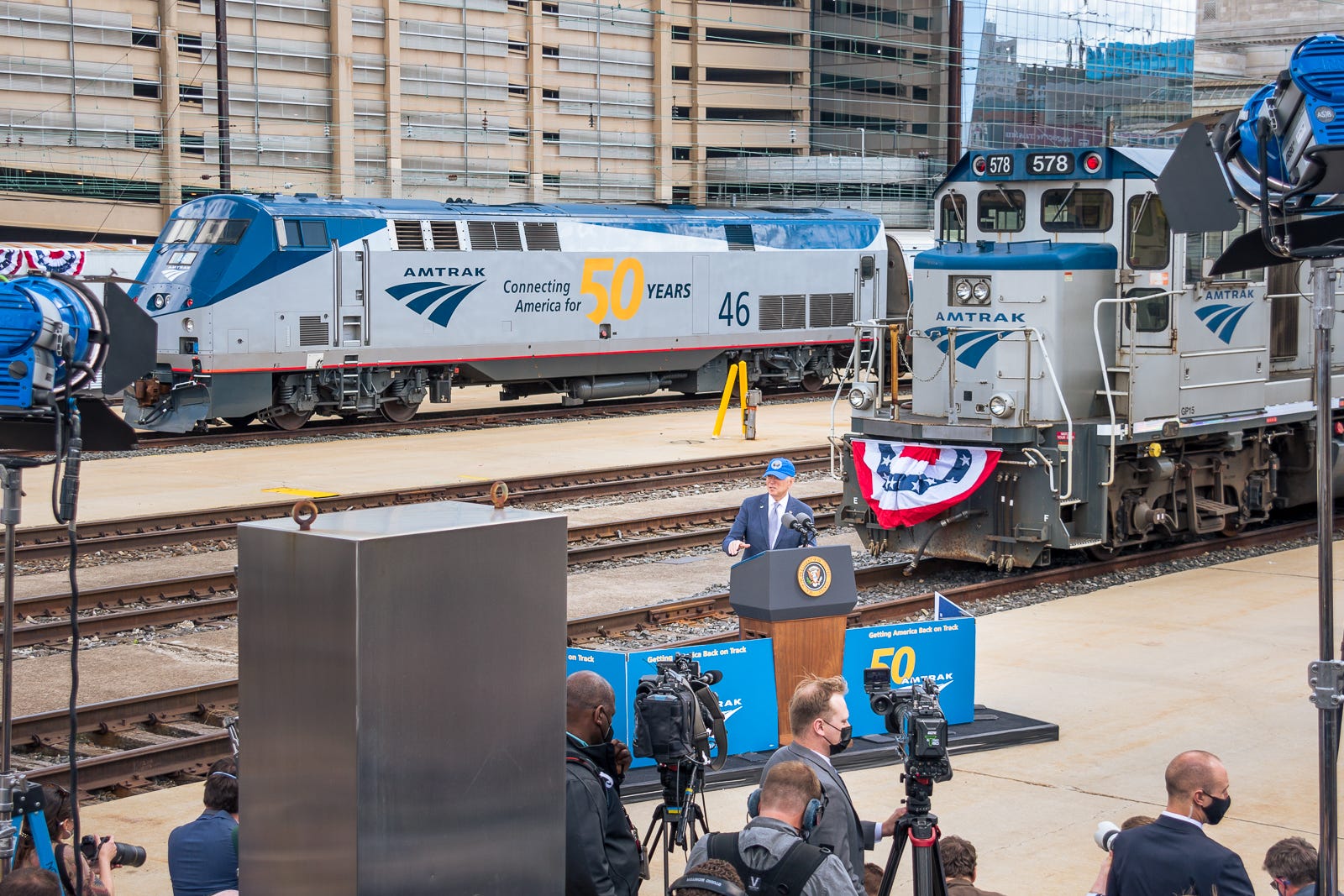
President Biden speaks at the 50th anniversary of Amtrak in Philadelphia, April 30, 2021 (amtrak.com)
All Aboard! Young folks may never have heard that welcoming cry from a conductor, except for railroad scenes in old movies. But for older generations, it once signaled that a delightful railway adventure was about to begin.
One day in October of last year, two ardent train fans headed for Chicago’s Union Station, eager to board the Floridian. Scheduled to depart at 6:40 p.m., it would be arriving in Washington D.C. soon after noon on the following day. We were traveling to D.C. not for a vacation or holiday, or on business, but to attend the second “No Kings” Rally in the nation’s capital.
Six months earlier, we’d been on that very same train, with the same destination, to cover the “Hands Off” demonstration at the Washington Monument as independent journalists. Now, we were eager to make that same trip for a second time, ready to relax and enjoy the 17.5-hour journey.
Most out-of-town journalists, like most people traveling to D.C. for any reason, wouldn’t be among us in one of the Coach cars. They’d be lined up at an airport, waiting to hear that their plane was about to begin boarding.
Quite a few years had passed since I’d last taken a train trip of any length – beyond the Chicago-Detroit run that I enjoyed periodically. My fascination with passenger trains dates back to a summer I spent in a tiny town in Michigan, at age 11. Because there was little to do during the day, I often wandered down to the train depot, to watch the telegraph operator at work and to stare into the distance, down the dead-straight track, when the “streamliner” was approaching from the north. Watching its headlight grow bigger and bigger as the diesel locomotive drew nearer made an indelible impression on one train-loving youngster.
That town of 350 residents, with one gas station and two taverns, had two trains each day, in each direction, stopping at that station. The “night” train was pulled by a steam engine.
Through the decades since, I took many a train trip, whether short-run or cross-country. In addition to covering much of the U.S., my rail-travel background includes a segmented journey from coast to coast on Canada’s VIA Rail system, preceded by a series of railroad adventures in Mexico. A number of European trains round out the list, along with some short-run treks around Tokyo.
Travel, for many of us, has become a bore, if not an irritant. Sitting in a car, driving mile after tedious mile on a freeway bereft of visual stimulation except for an occasional glimpse of the “golden arches.” Or in the air, trapped into position on the wings of tedium, munching on a glorified TV dinner with earphones affixed to one’s head to drown out the ceaseless drone of the jet engines. (Oh, wait; you don’t even get fed anymore unless you pay a hefty price in First Class or Business seats.)
How about enduring the human herding and the humdrum whine of the tires on any cross-country bus, hoping you won’t have a whining child or talkative drunk in the seat next to you. These are the ways that try the modern-day voyager’s mental processes, often initiating nothing more than a nagging wish to be where you’re headed rather than en route to that destination.
But wait – let’s not ignore that long-standing, alternative way to get there. It’s so unlikely a method of long-distance travel, so nearly forgotten as a means of enjoying the trip rather than the arrival, that many Americans seem only dimly aware that it still exists.
You do remember trains, don’t you? Those big boxes with steel wheels that sing you to sleep after a pleasant evening in the club car, lifting a few with a group of similarly carefree (for the time being, at least) ground travelers who enjoy the going as well as the getting there. Maybe more so.
Recent decades have produced plenty of propaganda against trains. From their introduction in the U.S. two centuries ago, through the completion of the transcontinental railroad in 1869, and into the 1950s, they were a principal mode of travel. Yet by the Sixties, they began losing out to airline travel, and the debut of Amtrak in 1971 didn’t help much in the end.
Yes, folks, trains are definitely and defiantly still with us. If some of the railroad enthusiasts who remain active have their way – against some mighty political forces that seem determined to reduce the number of track-laden miles to a tiny trickle across the landscape – they will be around for some time to come. Passenger trains will be ready to provide you and your family with a vacation or business trip to remember, rather than disappear from your mind once you’re reached your destination.
Let’s consider some of the benefits of train travel – followed by a few potentially obstacles.
FUN: It’s in the eye of the beholder, of course. While some people absolutely adore railroad travel and take advantage whenever possible, others wouldn’t dream of stepping aboard. Well, speaking as a former frequent flyer, planes and airports aren’t exactly joyful these days, either.
The rule used to be, getting there was half the fun. On a bus, for long-distance travel, it generally wasn’t. Way too crowded and difficult to sleep, rest stops were brief and infrequent, and passengers were herded like cattle into dubious eating establishment, given only minutes to satisfy hunger. By car, on the Interstates, you didn’t see much, and had to drive yourself. Nothing relaxing about that, for many people.
COMFORT: Some riders might feel cramped in a Coach seat, but most are likely to find them quite roomy, with ample leg space, helped by a useful footrest. Try it once and see for yourself. Seat styles vary among the different routes, so some are more inviting than others.
Sleeping in Coach seats is easy for some, as demonstrated by the number of snoring, non-moving passengers observed during a typical night on a long-distance run. For at least a fortunate few, sleeping on the train can be supreme pleasure – a period to savor.
Others might be able to manage nothing more than dozing, whereas some of us are certain to be wide awake for the full duration of our trip. As it happens, I fall into the latter category; but I’m unable to sleep on any sort of conveyance, including airplanes. So it goes.
Loud or unruly passengers are always a possibility, but nearly all the reports of such behavior nowadays seem to involve airlines. My only serious example dates back to the 1980s, on a train traveling through Canada. Two young men, obviously intoxicated to a worrisome level, were ready to retire for the night. Instead of stretching out in their Coach seats, they simply flopped onto the aisle floor, totally blocking access for all their fellow passengers. Later, a friend informed me that the two unworried gentlemen were likely from a particular part of the country, whose residents were known to have a reputation for falling into unruly behavior.
Cross-country travelers, at least, may have somewhere else to go for a quieter, more serene experience. Observation cars provides an expansive, inviting view of the surrounding in daylight, and are often uncrowded at night.
Privacy, provided you’ve opted for a Roomette or Bedroom is a delightful bonus, which is essentially absent in Coach travel.
CONVENIENCE: Aisles in Coach cars are narrow, requiring most passengers to cling to a series of seatbacks when leaving one’s seat is necessary. Walking through a series of cars to the Dining Car can be a chore if the train is rocking (which is periodically the case, on both long and short stretches of track). Tray tables fold down from each seatback, and are essential if you’re bringing food to your seat. Their usefulness for working varies, depending on the size and configuration of a laptop or other electronic device. Power outlets are usually right at hand. Lighting at night is usually quite helpful, but sometimes barely noticeable. Windows curtains may be adjusted readily to keep sunlight at bay, or can be closed completely during the night.
Like other aspects of train travel, restrooms vary in quantity and roominess. Most are bigger than those you have to endure on a plane, but a few contortions might be need to make use of the facilities.
TIME: Obviously, most train trips take much longer than on a plane; but that can be a prominent part of the pleasure, not a detriment. If you enjoy the overall experience, you’re actually living aboard that train for a day or two (or more), which means more hours to revel in the scenery, as well as welcome either the sense of communality or the pleasure of virtual solitude. Both responses are possible. A trip from Chicago to Los Angeles, for instance, takes about 47 hours.
LUXURY: There aren’t many ways for most of us to travel luxuriously anymore, without deep reaches into one’s pocketbook. For land travel, Amtrak is the only game in town. Is it luxury? Yes and no. Let’s call it semi-luxury. Not like the plush, old-time First Class accommodations of decades past, of course. Nor is the service quite of that caliber. But compared to car/bus travel, it’s a pleasure – especially in sleeping accommodations, which, unfortunately, are usually priced out of reach of most family budgets.
Then again, choosing a Roomette or a Bedroom can turn an ordinary trip into a truly memorable experience, and might be well worth the additional cost.
SEATING: Assigned seats aren’t usually the rule, as in the past; but they might be assigned by a conductor on the platform, just as you’re ready to step aboard. If not, you’re on your own in terms of seat selection. It could be a free-for-all, first-come-first-served.
Especially when boarding at a station other than the point of origin, you might face a crowded car with few seats available (and definitely not a pair of them). If you’re alone, seating doesn’t matter as much – though remember, on a long-distance run, you’ll be sitting with the same person for a lot of hours, so seeking a friendly face is prudent. Although it’s prudent practice for anyone, for a couple or family, it really pays to get to the desired Coach car as swiftly as possible, while keeping safety in mind. Coach cars tend to be at the far end, which means quite a long walk.
Best Bet: Be at the station well ahead of departure time, listen carefully to announcements, and be ready to move as soon as you get the word. Take advantage of any available early boarding opportunity (typically for seniors and the disabled).
Passengers are organized by destination, so those in your car are likely going where you are, or will depart at a station in the same region. On long-distance trains, if you’re not happy with your seat, there’s usually some place (observation car, snack car) to sit awhile. Also, seats will become available as passengers depart, at stations that come before yours.
MEALS: Longer-distance trains generally have a full, traditional Dining Car. Eating there isn’t cheap, but it’s tolerable by today’s restaurant standards. Dinner price is usually fixed (prix fixe), and most patrons see it as a special treat. Food is generally quite good, but I can attest from one bad dinner experience that a “bad apple” from the chef isn’t impossible.
Almost certainly, you’ll be at a table for four, with several strangers joining you. That’s a benefit of train travel for most, though not necessarily so much for shy loners like myself. Many travelers wind up talking about their dining-car experiences and the people they met for months or years afterward.
Snack-car food is cheaper, as expected, but admittedly less special. On shorter runs, there may be no seating for patrons, so you have to carry your purchase back to your seat. If you bring your own food or drink aboard, you’ll usually be obliged to consume it at your seat. Taking a seat in a snack or lounge car may be limited to those who make a purchase; or at least, no outside food is permitted.
COST: Coach fares are usually quite reasonable; Roomettes and Bedrooms, not. But since they may be considered almost a once-in-a-lifetime experience, the may be worth the indulgent expense. Not unlike airline fares, Amtrak prices vary by date. A recent round-trip between Chicago and Minneapolis, to view the Good and Pretti memorials, cost just $73 with the Senior discount. On a random upcoming date, riding from Chicago to Los Angeles back amounts to $240 in Coach, but a whopping $1,268 for sleeping accommodation.
Some Points to Consider
· Train travel for the newcomer can be a bit overwhelming at first. Or even very much so.
· Although many train cars look almost spotless, not all are maintained in A-1 shape. Older cars might considerable wear, but rarely to the point of interfering with the pleasure of your trip. A few scratches and dents here and there can actually bring on a wistful reminscence of train travel in the olden days.
· Most of the time, announcements are made clearly and helpfully. But exceptions can occur, leaving passengers unsure of what’s happening, at least for a while.
· Late arrivals are not uncommon; many horror stories of excessively lengthy or troublesome journeys can be heard from some unhappy riders. On the other hand, you’re likely to hear stories of new people met over dinner, enthralling sights observed as your Coach glides through the landscape, and other lingering memories.
· Delays along the way can occur for a variety of reasons. On our most recent trip, the train came to a halt two stations ahead of our destination, unable to proceed farther. Why? A section of track up ahead had broken. We were taken to our destination by three buses, hurriedly ordered by Amtrak.
· Breadth of Amtrak service isn’t what it used to be – and far more limited than in pre-Amtrak times. Not every major destination has passenger train service, and some sizable regions have no rail routes at all.
· Amtrak’s website isn’t the easiest to navigate; but once you get to the details of your desired route, purchasing tickets is pleasantly straightforward. Ticketing can also be done by phone.
Yes, doubters may have to accept a few imperfections if they choose this old-fashioned mode of travel, but many might be surprisingly delighted by the joyful aspects of the journey. For diehard train lovers, the problems are no obstacle; they can concentrate on the good points. For some infrequent or rare rail travelers, troubles can seem glaring, and overshadow the pleasantries. Nearly all are likely to experience the sensation of “being away from it all” for a far-from-hectic period of hours. Or days. Best to keep in mind that imperfections may indeed come up; but they do on other modes of travel, too.
At the Station….
BOARDING: At small stations, it’s a breeze. In big cities, the boarding process can be hectic and confusing. Traditional stations in major cities are massive, and you might begin to feel you’re part of a herd being led along a nearly endless ramp to nowhere. Then again, airline boarding in an unfamiliar airport can be bewildering, too.
Provided that you’re already ticketed, Step One is to locate the waiting area. It might be adjacent to the gates where trains stand waiting, or elsewhere in the station. Most stations have a separate waiting room for senior and disabled passengers. They might also be offered an opportunity for early boarding, thus getting ahead of the crowd of passengers who will be clamoring to find suitable seats. Take advantage of both, if you qualify. If not, plan to walk rapidly, especially if you and your group hope to get seats together.
Pay close attention to announcements and details. If in doubt, don’t hesitate to ask an employee what to do next, or where to go. Once a departure is announced, follow other boarding passengers – but make sure they’re headed for the same train that you are.
Be prepared to walk quite a long distance. Boarding platforms in major cities are quite lengthy, and the Coach car carrying passengers to your destination might be at the very end, just behind the locomotive. As you walk, you’ll likely pass the sleeping cars and diner. Take care when stepping aboard the designed car; it’s likely to be a tall step upward.
There should be a free, motorized conveyance for those who cannot walk on their own, or simply don’t feel able at present. It’s generally available to all passengers.
ARRIVAL: Arriving at your destination is usually less hectic; but again, in big cities, a lot of walking may be involved. So be prepared or, if need be, take one of those electric conveyances. Or, ask a porter or other employee for assistance.
A Little Railroad History… with few rays of hope
It’s no secret that train travel, once the foremost mode of long-distance transportation in America, has been on the decline for decades. Ever since 1971, to be precise, when Amtrak first saw the light of day, a year after the National Railroad Passenger Corporation was created.
Except for the East Coast, where rail passengers enjoy frequent, rapid service between major cities, Amtrak has declined into an almost forgotten entity by the general public. But not by the many devotees and ardent advocates of passenger travel on tracks, who strive to keep railroad travel alive indefinitely.
Thousands of moderate-distance travelers commute daily between Boston, New York, and Washington D.C. Elsewhere, the trains have been carrying few passengers and operating on increasingly smaller schedules than ever before. For most Americans, the short-distance urban commuter train is the only one they’re likely to board.
Sad to report, plenty of younger folks (and quite a few older travelers) have never ridden a train at all. They’re joined by adults who haven’t one in ten, twenty, or more years. Most of them likely never give a moment’s thought to rail travel when planning a longer-distance trip.
It’s sad, really. We’ve grown so accustomed to airplanes and automobiles for long distances, and possibly buses for short trips, that the passenger train has approached near-extinction more than once. Americans might travel more often, and for greater distances, than ever before; but few of them even consider the train as a possibility. If they think of rail travel at all, they’re likely to focus on potential discomforts rather than pleasures and benefits.
The businessperson who chooses to travel by train is typically perceived as an oddity. He must be terrified of airplanes. Why else would he disdain the near-supersonic velocity of the jet plane for the plodding constancy of steel wheels on rails?
Why has the one form of group transport with the greatest potential for energy-saving, (reasonably) high-speed, mostly comfortable conveyance over long distances fallen into such dismal days. How has the behemoth of the transportation industry, the giant force that tamed the American West in the nineteenth century and provided fast, dependable interstate transportation for so many, for so long, come so close to going the way of the dinosaur?
Part of the reason is Amtrak itself. In an attempt to operate at a profit (or at least, at less of a loss), money has not been spent at a sufficient rate to improve train service. Dozens, if not hundreds of small cities and towns across the country, which once were served by one, two, or three trains each day, have had no rail service at all for decades. By the end of the Seventies, a startling number of routes had been dropped completely; and in all the years since, few have been added to take their place. That shortfall leaves plenty of Americans stranded, with no useful public transportation at all.
Greyhound and Trailways bus lines, once strong competitors for budget-priced transportation over middling to long distances, similarly faded out of the travel picture ages ago. Both still exist, thankfully, with regular schedules for selected routes; but their heyday is long since gone. Not too many travelers place a bus at the top of their preferences for a lengthy trip. The thought of occupying a cramped seat for hours, even for days, with only brief “rest” or meal stops along the way, doesn’t exactly inspire delightful expectations.
Over the years, some teachers have initiated programs to take groups of children on short rail journeys, just so they could have that experience. For many or most, it was doubtless the first (and maybe last) time.
Ever since the emergence of Amtrak and the tumultuous arguments over funding, passenger-train arrival has become more a butt of jokes than a recommended means of long-distance travel. One commentator even proclaimed that there are only ten people in America who enjoy or favor trains, and nine of those are travel writers.
Remember the mocking comments that emerged when President Biden was well known to favor train travel, riding the rails regularly through the modest distance between his home and the White House? Can anyone imagine the current president stepping aboard?
It seems like eons ago, but for business travel as well as personal pleasure trips, the voyage itself was viewed as an integral part of the joy of going to a new place. For most of us, that day is gone. High-speed rail travel in the U.S., for instance, has been promised for years; but in reality, little has been accomplished.
In Europe, and in most other parts of the world, rail travel has managed to remain almost as big and viable as ever. Around the United Kingdom, for instance, trains still tend to be packed with eager travelers, who can reach almost every city and town and village of any size in comfort and convenience. In nearly every big-city station, huge wall-mounted electronic schedules show dozens upon dozens of trains departing and arriving in the next couple of hours.
Sadly, Mexico is not among the nations that offer train travel. Railways were privatized in the 1990s and passenger trains disappeared completely, despite their long history – including their iconic role in the 1910 Revolution. Not many people, Mexican or American, can say they have distinct memory of traversing that country on a network of rails. As it happens, I am one who can.
In our next commentary on train travel, we’ll take a personal look back at the joys (and irritants) of traveling around Mexico in the 1980s, when passenger trains still ran. In recent years, the Mexican government has been working on reviving one or two passenger routes, but development has been unsteady. Even if successful, it won’t be the same as riding a leftover American rail Coach – likely built in the 1950s – from the high elevation of Mexico City, through the jungle to Veracruz on the eastern coast. Or, enjoying/enduring a nine-hour trip to San Luis Potosi that turned into a 37-hour adventure. Though I might have grumbled and groused about that seemingly permanent delay at the time (in contrast to my late wife, Marianne, who accurately considered it an adventure to savor), it’s my most memorable train journey ever.
© All contents copyright 2026 by James M. Flammang (Tirekicking Today)
Image Source: Amtrak