
Solidarity Forever? ... Is there still a place for unions in tomorrow's world?
Angular Views on ... Labor

"When the union's inspiration through the worker's blood shall run...." That's the opening line of Solidarity Forever, perhaps the foremost and most familiar of the old union anthems, penned by Ralph Chaplin in 1915. Next stanza: "There can be no power greater anywhere beneath the sun."
Well, the once-mighty power of the union movement slipped away long ago, as the entire process of working began to undergo a transformation. Union membership today is but a shadowy fraction of the totals seen during the heyday of the labor movement: roughly, the 1920s through the 1950s.
Unions are still around, of course. In 2023, about 10 million workers belonged to a union. But that’s half the number of union members four decades ago, in 1983, according to the Bureau of Labor Statistics.
When the Great Depression began, about 10.7 percent of non-agricultural workers belonged to unions. Even as unemployment skyrocketed during the next few years, union membership rose – apart from a dip in 1933, the nation’s economic low point. After President Franklin D. Roosevelt signed the National Labor Relations Act in 1935, union membership began a steady upward climb, before flattening during the 1950s. Membership peaked in 1953, at 32.7 percent, according to BLS figures. By the end of that decade, a decline was underway.
By 1983, union membership had sunk to just 20.1 percent of workers, according to Statista. From that point all the way to the present day, the decline was nearly constant, finally reaching that worrisome 10 percent figure in 2023.
Some of today’s unions actually remain quite potent, at least within their particular spheres. But the ultimate weakness of even the strongest unions shows up when the corporate/political powers choose to demonstrate their will.
That's what happened back in 2008, near the beginning of the financial “crisis” of that period. Before granting a "bridge loan" to General Motors and Chrysler (now called Stellantis), Republicans in Congress pressured President George W. Bush to insist that the United Auto Workers Union (UAW) would agree to wages that matched those given to non-union workers in southern-state factories. A number of auto plants had been setting up plants in the south, in “right to work” states, in part to avoid paying union wages that were mandatory in the north.
Not that President Bush needed much pressuring on that score. Like his presumed idol, Ronald Reagan – who broke the air traffic controllers' union during his own term – Bush was no friend to the labor movement. His successor, Barack Obama, may have held a more favorable view; but for most of his tenure, the presence and strength of unions remained muted.
Critics have regularly pointed to what they claim is the excessive influence of certain labor organizations that retain a degree of power, most notably the United Auto Workers. During that quandary about "bailout" money for GM and Chrysler, opponents regularly cited the UAW as a prominent cause for those corporate travesties. If only those Detroit workers would accept reduction to earnings levels enjoyed by their non-union counterparts at import-brand auto plants in the southern states, they insisted, the auto companies would be able to survive and regain strength.
At the current stage in labor history, the UAW has been fully able to fight its own battles. All the more so with the election of the fiery advocate Shawn Fain as president in 2023.
Not so, the millions of unorganized workers across the country, who had long been ignored both by business and labor – with several notable exceptions on the part of activists for hotel workers and the like. Clearly, the need for unionization has been, and remains, greatest among the lowest-paid workers, who are the most vulnerable. Their depressed state was recognized more than a century ago by the Industrial Workers of the World (IWW), the "one big union" that was formed to organize unskilled workers who were typically shunned by the labor organizations of that era.
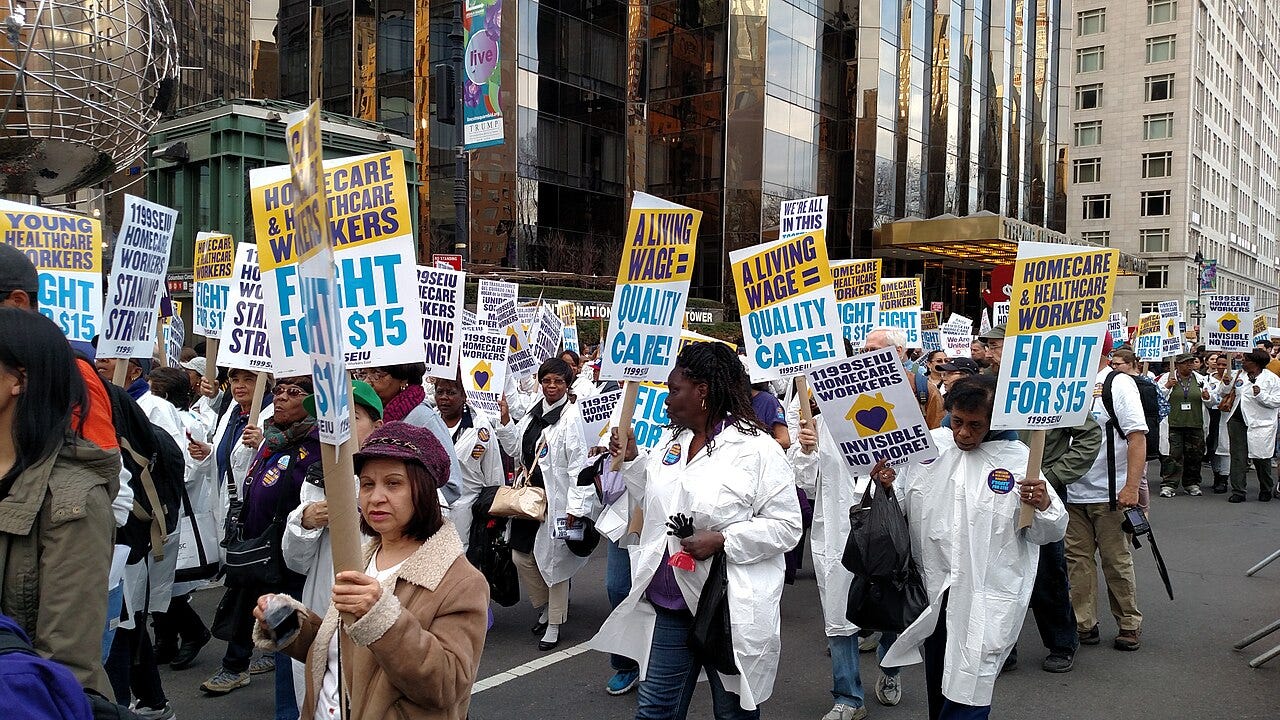
Protest in NYC (April 2015): Low-wage, low-status workers are the very ones who need unions most – yet they're the toilers most often ignored.
Not until the advent of the "Fight For $15" movement in 2012, pushing for an adequate minimum wage, did low-wage earners start to become seriously noticed – and effective. Surprisingly quickly over the next few years, one city, one state, after another took up the mantle of boosting the minimum wage in that locale, even though the federal rate remained stagnant. Most recently, the Illinois legislature agreed to $15 per hour. Some areas have proposed even higher figures: $15, $17, even $20. Yet even today, in 2025, the federal minimum, last increased in 2009, is an unrealistically puny $7.25 per hour.
How any president's administration handles issues like the "card check" question, which can change the procedure for workers adopting union representation, should give a clear signal of what labor can expect. Critics have long charged that Democrats in Congress have been beholden to the unions – as if that would be more dastardly than being in the pocket of corporate interests, as far too many Republicans inevitably appear to be.
As the 2020 presidential election loomed, organized labor remained "on the ropes." Sadly, allegations of corruption in traditional unions continued to emerge periodically, some of them affirmed by financial behavior of top leaders. Early that year, of course, came a far different blow: the emergence of the Covid-19 pandemic, resulting not only in grave illness and shocking numbers of deaths, but in the loss of “tens of millions” of jobs “in the early months of the crisis,” according to the Center on Budget and Policy Priorities.
With an erratic, business-first Donald Trump at the helm in his first administration as president, advancing (or maintaining) the status of labor presented even greater challenges. Yet, a potentially brilliant ray of hope could be perceived as the pandemic and consequent job-loss eased, that "Fight For $15" agenda re-emerged (joined by other like-minded organizations), and even more low- and middle-wage workers found their voice and raised it loudly.
As the furor over immigration continued to fester during the Biden/Harris administration, however, efforts to improve the lot of restaurant workers, cleaning staffs, and other occupations that are often filled by immigrants who lack legal status to work in the United States faced monumental opposition. Those hopes for advancement of labor sunk dramatically late in 2024, with president-elect Trump vowing, immediately upon taking office again, to begin rounding up millions of undocumented persons and families, likely transporting them to holding camps while awaiting deportation. He has even put forth the notion of employing military forces to assist with that goal – despite the fact that the military is not supposed to be deployed for domestic purposes.
Perhaps we need a rebirth of some of the most forceful labor leaders of the distant past, from Samuel Gompers to Walter Reuther, Eugene Debs to Cesar Chavez, and even the IWW’s “Big Bill” Hatwood and Joe Hill. Meanwhile, labor advocates need to applaud the efforts and enthusiasm of non-traditional unions and such activist groups as Labor Notes.
© All contents copyright 2024 by James M. Flammang (Tirekicking Today)
Image Source: Wikimedia Creative Commons – The All-Nite Images at https://flickr.com/photos/7278633@N04/16974152260